




Nikon D4 vs Sony A7 IV
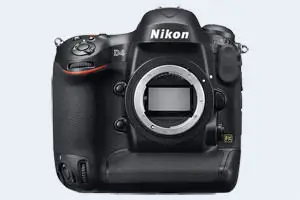
The Nikon D4 and the Sony Alpha A7 IV are two digital cameras that were officially introduced, respectively, in January 2012 and October 2021. The D4 is a DSLR, while the A7 IV is a mirrorless interchangeable lens camera. Both cameras are equipped with a full frame sensor. The Nikon has a resolution of 16.2 megapixels, whereas the Sony provides 32.7 MP.
Below is an overview of the main specs of the two cameras as a starting point for the comparison.
|
 |

|
|---|---|---|
| Nikon D4 | Sony A7 IV | |
| Digital single lens reflex | Mirrorless system camera | |
| Nikon F mount lenses | Sony E mount lenses | |
| 16.2 MP – Full Frame sensor | 32.7 MP – Full Frame sensor | |
| 1080/30p Video | 4K/60p Video | |
| ISO 100-12,800 (50 - 204,800) | ISO 100-51,200 (50 - 204,800) | |
| Optical viewfinder | Electronic viewfinder (3686k dots) | |
| 3.2" LCD – 921k dots | 3.0" LCD – 1037k dots | |
| Fixed screen (not touch-sensitive) | Swivel touchscreen | |
| 11 shutter flaps per second | 10 shutter flaps per second | |
| Lens stabilization only | In-body stabilization | |
| Weathersealed body | Weathersealed body | |
| 2600 shots per battery charge | 580 shots per battery charge | |
| 160 x 157 x 91 mm, 1340 g | 131 x 96 x 80 mm, 659 g |

Check D4 offers at
ebay.com

Check A7 IV price at
amazon.com
Going beyond this snapshot of core features and characteristics, what are the differences between the Nikon D4 and the Sony Alpha A7 IV? Which one should you buy? Read on to find out how these two cameras compare with respect to their body size, their imaging sensors, their shooting features, their input-output connections, and their reception by expert reviewers.
' x='-300' width='300' height='300' fill='%23fff' style='paint-order:markers fill stroke'/%3E%3Cg transform='scale(2.9126)' fill='%23fff' fill-rule='evenodd'%3E%3Cg fill='%2300aecd'%3E%3Cpath d='m63 67v-31h2.93c8.408-0.207 14.11 4.626 14.07 15.5 0.04 11.158-5.377 15.707-13.928 15.5zm-20-44 20 57h4c19.453 0 30-11.656 30-28.5 0-17.128-10.405-28.5-30-28.5zm-14.887 34.495 5.36-17.95 5.388 17.95h-10.747zm-2.113-34.495-20 57h15.453l2.835-9.674 18.415-0.044 2.882 9.718h15.415l-20-57z'/%3E%3C/g%3E%3C/g%3E%3C/svg%3E%3Csvg id='d' width='300px' height='300px' viewBox='0 0 15 15'%3E%3Cstyle%3E.bg%7Bfill:%23ffffff%3B%7D .icon%7Bstroke-width:1.25%3Bstroke:%2300aecd%3B%7D%3C/style%3E%3Cpath class='bg' d='m0 0h15v15h-15'/%3E%3Cpath class='icon' d='m3.25 3.25 8.5 8.5m0-8.5-8.5 8.5'/%3E%3C/svg%3E%3C/defs%3E%3Cuse xlink:href='%23c'/%3E%3Cuse x='300px' xlink:href='%23d'/%3E%3C/svg%3E)
Body comparison
The physical size and weight of the Nikon D4 and the Sony A7 IV are illustrated in the side-by-side display below. The two cameras are presented according to their relative size. Three consecutive perspectives from the front, the top, and the back are available. All width, height and depth dimensions are rounded to the nearest millimeter.
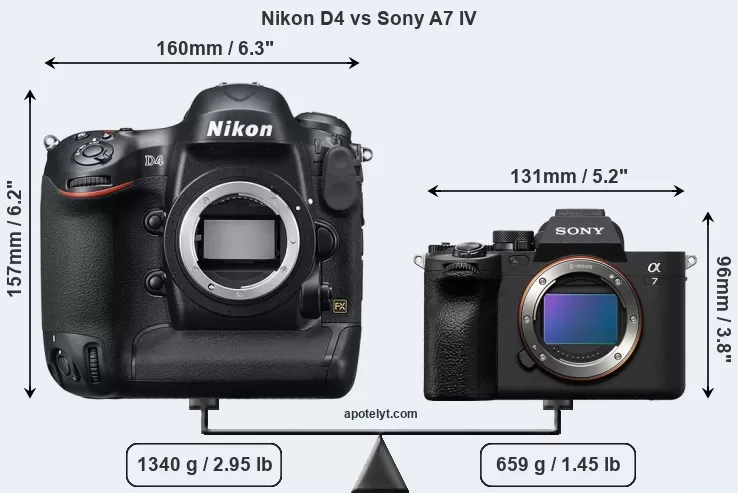
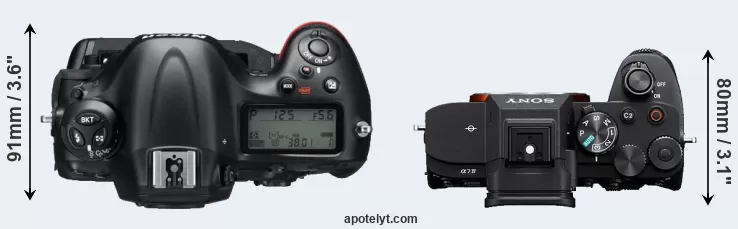
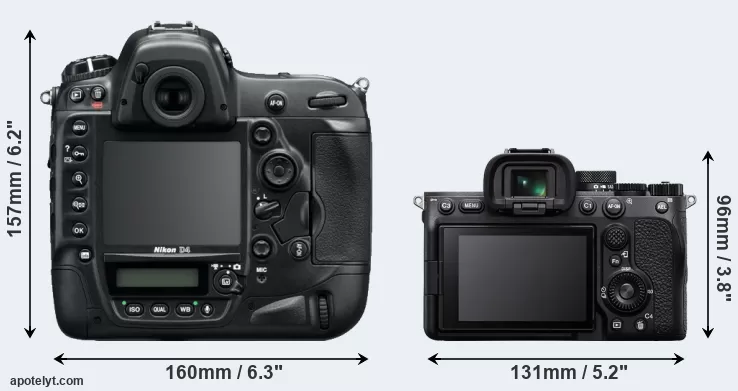
If the front view area (width x height) of the cameras is taken as an aggregate measure of their size, the Sony A7 IV is considerably smaller (50 percent) than the Nikon D4. Moreover, the A7 IV is substantially lighter (51 percent) than the D4. In this context, it is worth noting that both cameras are splash and dust-proof and can, hence, be used in inclement weather conditions or harsh environments.
The above size and weight comparisons are to some extent incomplete since they do not consider the interchangeable lenses that both of these cameras require. Both cameras have similarly sized sensors, but DSLRs have a larger flange-to-focal plane distance than mirrorless cameras, which imposes contraints on the optical engineering process and generally leads to bigger and heavier lenses. You can compare the optics available for the two cameras in the Nikon Lens Catalog (D4) and the Sony FE Lens Catalog (A7 IV). Mirrorless cameras, such as the A7 IV, have moreover the advantage that they can use many lenses from other systems via adapters, as they have a relatively short flange to focal plane distance.
Concerning battery life, the D4 gets 2600 shots out of its Nikon EN-EL18 battery, while the A7 IV can take 580 images on a single charge of its Sony NP-FZ100 power pack. As can be seen in the images above, the D4 has a battery grip built in. This facilitates image-taking in portrait orientation and gives it additional battery power. In order to provide similar functionality for the A7 IV, Sony provides the VG-C4EM vertical grip as an optional accessory (see here on ebay). The power pack in the A7 IV can be charged via the USB port, which can be very convenient when travelling.
The following table provides a synthesis of the main physical specifications of the two cameras and other similar ones. In case you want to display and compare another camera duo, you can use the CAM-parator app to select your camera combination among a large number of options.

|
Camera Model |
Camera Width |
Camera Height |
Camera Depth |
Camera Weight |
Battery Life |
Weather Sealing |
Camera Launch |
Launch Price |
Street Price |
|
|---|---|---|---|---|---|---|---|---|---|---|---|
| 1. | Nikon D4 | 160 mm | 157 mm | 91 mm | 1340 g | 2600 |  | Jan 2012 | US$ 5 999 | ebay.com | |
| 2. | Sony A7 IV | 131 mm | 96 mm | 80 mm | 659 g | 580 | | Oct 2021 | US$ 2 499 | amazon.com | |
| 3. | Canon 1D X | 158 mm | 168 mm | 83 mm | 1551 g | 1120 | | Oct 2011 | US$ 6 799 | ebay.com | |
| 4. | Nikon D3 | 160 mm | 157 mm | 88 mm | 1300 g | 4300 | | Aug 2007 | US$ 4 999 | ebay.com | |
| 5. | Nikon D3S | 160 mm | 157 mm | 88 mm | 1240 g | 4200 | | Oct 2009 | US$ 5 199 | ebay.com | |
| 6. | Nikon D3X | 160 mm | 157 mm | 88 mm | 1260 g | 4400 | | Dec 2008 | US$ 7 999 | ebay.com | |
| 7. | Nikon D4S | 160 mm | 157 mm | 91 mm | 1350 g | 3020 | | Feb 2014 | US$ 6 499 | ebay.com | |
| 8. | Nikon D5 | 160 mm | 159 mm | 92 mm | 1415 g | 3780 | | Jan 2016 | US$ 6 499 | ebay.com | |
| 9. | Nikon D600 | 141 mm | 113 mm | 82 mm | 850 g | 900 | | Sep 2012 | US$ 2 099 | ebay.com | |
| 10. | Nikon D800 | 146 mm | 123 mm | 82 mm | 1000 g | 900 | | Feb 2012 | US$ 2 999 | ebay.com | |
| 11. | Nikon D800E | 146 mm | 123 mm | 82 mm | 1000 g | 900 | | Feb 2012 | US$ 3 299 | ebay.com | |
| 12. | Nikon Df | 144 mm | 110 mm | 67 mm | 760 g | 1400 | | Nov 2013 | US$ 2 749 | ebay.com | |
| 13. | Sony A1 | 129 mm | 97 mm | 81 mm | 737 g | 530 | | Jan 2021 | US$ 6 499 | amazon.com | |
| 14. | Sony A7 III | 127 mm | 96 mm | 74 mm | 650 g | 610 | | Feb 2018 | US$ 1 999 | amazon.com | |
| 15. | Sony A7R IIIA | 127 mm | 96 mm | 74 mm | 650 g | 650 | | Apr 2021 | US$ 3 199 | amazon.com | |
| 16. | Sony A7R V | 131 mm | 97 mm | 82 mm | 723 g | 530 | | Oct 2022 | US$ 3 899 | amazon.com | |
| 17. | Sony A7S III | 127 mm | 97 mm | 81 mm | 699 g | 600 | | Jul 2020 | US$ 3 499 | amazon.com | |
| Note: Measurements and pricing do not include easily detachable parts, such as add-on or interchangeable lenses or optional viewfinders. | |||||||||||
|
Camera Model |
Camera Width |
Camera Height |
Camera Depth |
Camera Weight |
Battery Life |
Weather Sealing |
Camera Launch |
Launch Price |
Street Price |
|
|
Camera Model |
||||||||||
The price is, of course, an important factor in any camera decision. The manufacturer’s suggested retail prices give an idea on the placement of the camera in the maker’s lineup and the broader market. The A7 IV was launched at a markedly lower price (by 58 percent) than the D4, which puts it into a different market segment. Usually, retail prices stay at first close to the launch price, but after several months, discounts become available. Later in the product cycle and, in particular, when the replacement model is about to appear, further discounting and stock clearance sales often push the camera price considerably down. Then, after the new model is out, very good deals can frequently be found on the pre-owned market.
Sensor comparison
The size of the sensor inside a digital camera is one of the key determinants of image quality. A large sensor will tend to have larger individual pixels that provide better low-light sensitivity, wider dynamic range, and richer color-depth than smaller pixel-units in a sensor of the same technological generation. Moreover, a large sensor camera will give the photographer more control over depth-of-field in the image and, thus, the ability to better isolate a subject from the background. On the downside, larger sensors are more costly to manufacture and tend to lead to bigger and heavier cameras and lenses.
Both cameras under consideration feature a full frame sensor, but their sensors differ slightly in size. They nevertheless have the same format factor of 1.0. Both cameras have a native aspect ratio (sensor width to sensor height) of 3:2.
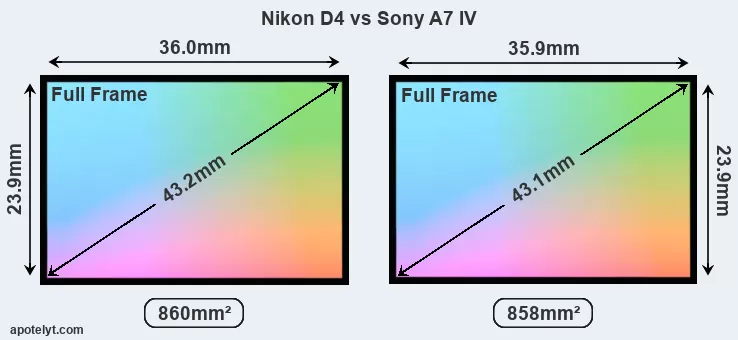
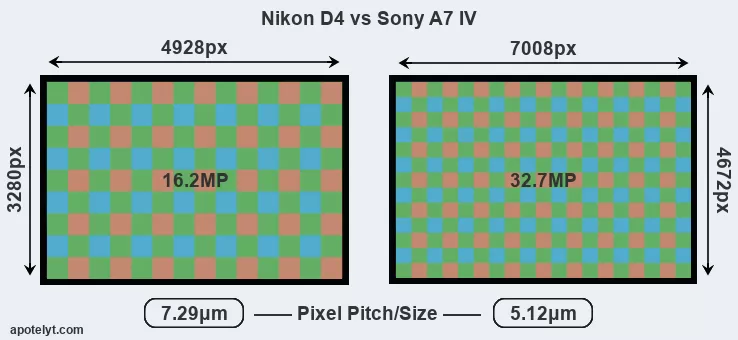
Despite having a slightly smaller sensor, the A7 IV offers a higher resolution of 32.7 megapixels, compared with 16.2 MP of the D4. This megapixels advantage comes at the cost of a higher pixel density and a smaller size of the individual pixel (with a pixel pitch of 5.12μm versus 7.29μm for the D4). However, it should be noted that the A7 IV is much more recent (by 9 years and 9 months) than the D4, and its sensor will have benefitted from technological advances during this time that make it possible to gather light more efficiently. Coming back to sensor resolution, it should be mentioned that the A7 IV has no anti-alias filter installed, so that it can capture all the detail its sensor resolves.
The resolution advantage of the Sony A7 IV implies greater flexibility for cropping images or the possibility to print larger pictures. The maximum print size of the A7 IV for good quality output (200 dots per inch) amounts to 35 x 23.4 inches or 89 x 59.3 cm, for very good quality (250 dpi) 28 x 18.7 inches or 71.2 x 47.5 cm, and for excellent quality (300 dpi) 23.4 x 15.6 inches or 59.3 x 39.6 cm. The corresponding values for the Nikon D4 are 24.6 x 16.4 inches or 62.6 x 41.7 cm for good quality, 19.7 x 13.1 inches or 50.1 x 33.3 cm for very good quality, and 16.4 x 10.9 inches or 41.7 x 27.8 cm for excellent quality prints.
The A7 IV has on-sensor phase detect pixels, which results in fast and reliable autofocus acquisition even during live view operation.
The Nikon D4 has a native sensitivity range from ISO 100 to ISO 12800, which can be extended to ISO 50-204800. The corresponding ISO settings for the Sony Alpha A7 IV are ISO 100 to ISO 51200, with the possibility to increase the ISO range to 50-204800.
In terms of underlying technology, the D4 is build around a CMOS sensor, while the A7 IV uses a BSI-CMOS imager. Both cameras use a Bayer filter for capturing RGB colors on a square grid of photosensors. This arrangement is found in most digital cameras.
For many cameras, data on sensor performance has been reported by DXO Mark. This service assesses and scores the color depth ("DXO Portrait"), dynamic range ("DXO Landscape"), and low-light sensitivity ("DXO Sports") of camera sensors, and also publishes an overall camera score. Of the two cameras under consideration, the A7 IV has a markedly higher DXO score than the D4 (overall score 8 points higher), which will translate into better image quality. The advantage is based on 0.7 bits higher color depth, 1.6 EV in additional dynamic range, and 0.2 stops in additional low light sensitivity. The following table provides an overview of the physical sensor characteristics, as well as the sensor quality measurements for a selection of comparators.
|
Camera Model |
Sensor Class |
Resolution (MP) |
Horiz. Pixels |
Vert. Pixels |
Video Format |
DXO Portrait |
DXO Landscape |
DXO Sports |
DXO Overall |
|
|---|---|---|---|---|---|---|---|---|---|---|---|
| 1. | Nikon D4 | Full Frame | 16.2 | 4928 | 3280 | 1080/30p | 24.7 | 13.1 | 2965 | 89 | |
| 2. | Sony A7 IV | Full Frame | 32.7 | 7008 | 4672 | 4K/60p | 25.4 | 14.7 | 3379 | 97 | |
| 3. | Canon 1D X | Full Frame | 17.9 | 5184 | 3456 | 1080/30p | 23.8 | 11.8 | 2786 | 82 | |
| 4. | Nikon D3 | Full Frame | 12.1 | 4256 | 2832 |  | 23.5 | 12.2 | 2290 | 81 | |
| 5. | Nikon D3S | Full Frame | 12.1 | 4256 | 2832 | 720/24p | 23.5 | 12.0 | 3253 | 82 | |
| 6. | Nikon D3X | Full Frame | 24.4 | 6048 | 4032 | | 24.7 | 13.7 | 1992 | 88 | |
| 7. | Nikon D4S | Full Frame | 16.2 | 4928 | 3280 | 1080/60p | 24.4 | 13.3 | 3074 | 89 | |
| 8. | Nikon D5 | Full Frame | 20.7 | 5588 | 3712 | 4K/30p | 25.1 | 12.3 | 2343 | 88 | |
| 9. | Nikon D600 | Full Frame | 24.2 | 6016 | 4016 | 1080/30p | 25.1 | 14.2 | 2980 | 94 | |
| 10. | Nikon D800 | Full Frame | 36.2 | 7360 | 4912 | 1080/30p | 25.3 | 14.4 | 2853 | 95 | |
| 11. | Nikon D800E | Full Frame | 36.2 | 7360 | 4912 | 1080/30p | 25.6 | 14.3 | 2979 | 96 | |
| 12. | Nikon Df | Full Frame | 16.2 | 4928 | 3280 | | 24.6 | 13.1 | 3279 | 89 | |
| 13. | Sony A1 | Full Frame | 49.8 | 8640 | 5760 | 8k/30p | 25.9 | 14.5 | 3163 | 98 | |
| 14. | Sony A7 III | Full Frame | 24.0 | 6000 | 4000 | 4K/30p | 25.0 | 14.7 | 3730 | 96 | |
| 15. | Sony A7R IIIA | Full Frame | 42.2 | 7952 | 5304 | 4K/30p | 26.0 | 14.7 | 3523 | 100 | |
| 16. | Sony A7R V | Full Frame | 60.2 | 9504 | 6336 | 8k/24p | 26.5 | 14.8 | 3187 | 100 | |
| 17. | Sony A7S III | Full Frame | 12.0 | 4240 | 2832 | 4K/120p | 23.7 | 13.9 | 2520 | 86 | |
|
Camera Model |
Sensor Class |
Resolution (MP) |
Horiz. Pixels |
Vert. Pixels |
Video Format |
DXO Portrait |
DXO Landscape |
DXO Sports |
DXO Overall |
|
|
Camera Model |
Many modern cameras are not only capable of taking still images, but also of capturing video footage. Both cameras under consideration are equipped with sensors that have a sufficiently high read-out speed for moving images, but the A7 IV provides a better video resolution than the D4. It can shoot movie footage at 4K/60p, while the Nikon is limited to 1080/30p.
Feature comparison
Apart from body and sensor, cameras can and do differ across a variety of features. For example, the A7 IV has an electronic viewfinder (3686k dots), while the D4 has an optical one. Both systems have their advantages, with the electronic viewfinder making it possible to project supplementary shooting information into the framing view, whereas the optical viewfinder offers lag-free viewing and a very clear framing image. The viewfinders of both cameras offer the same field of view (100%), but the viewfinder of the A7 IV has a higher magnification than the one of the D4 (0.78x vs 0.70x), so that the size of the image transmitted appears closer to the size seen with the naked human eye. The adjacent table lists some of the other core features of the Nikon D4 and Sony A7 IV along with similar information for a selection of comparators.
|
Camera Model |
Viewfinder (Type or 000 dots) |
Control Panel (yes/no) |
LCD Specifications (inch/000 dots) |
LCD Attach- ment |
Touch Screen (yes/no) |
Max Shutter Speed * |
Max Shutter Flaps * |
Built-in Flash (yes/no) |
Built-in Image Stab |
|
|---|---|---|---|---|---|---|---|---|---|---|---|
| 1. | Nikon D4 | optical | | 3.2 / 921 | fixed | | 1/8000s | 11.0/s | | |
|
| 2. | Sony A7 IV | 3686 | | 3.0 / 1037 | swivel | | 1/8000s | 10.0/s | | |
|
| 3. | Canon 1D X | optical | | 3.2 / 1040 | fixed | | 1/8000s | 14.0/s | | |
|
| 4. | Nikon D3 | optical | | 3.0 / 922 | fixed | | 1/8000s | 11.0/s | | |
|
| 5. | Nikon D3S | optical | | 3.0 / 921 | fixed | | 1/8000s | 11.0/s | | |
|
| 6. | Nikon D3X | optical | | 3.0 / 922 | fixed | | 1/8000s | 5.0/s | | |
|
| 7. | Nikon D4S | optical | | 3.2 / 921 | fixed | | 1/8000s | 11.0/s | | |
|
| 8. | Nikon D5 | optical | | 3.2 / 2359 | fixed | | 1/8000s | 14.0/s | | |
|
| 9. | Nikon D600 | optical | | 3.0 / 921 | fixed | | 1/4000s | 5.5/s | | |
|
| 10. | Nikon D800 | optical | | 3.2 / 921 | fixed | | 1/8000s | 4.0/s | | |
|
| 11. | Nikon D800E | optical | | 3.2 / 921 | fixed | | 1/8000s | 4.0/s | | |
|
| 12. | Nikon Df | optical | | 3.2 / 921 | fixed | | 1/4000s | 5.5/s | | |
|
| 13. | Sony A1 | 9437 | | 3.0 / 1440 | tilting | | 1/8000s | 30.0/s | | |
|
| 14. | Sony A7 III | 2359 | | 3.0 / 922 | tilting | | 1/8000s | 10.0/s | | |
|
| 15. | Sony A7R IIIA | 3686 | | 3.0 / 2340 | tilting | | 1/8000s | 10.0/s | | |
|
| 16. | Sony A7R V | 9440 | | 3.2 / 2100 | full-flex | | 1/8000s | 10.0/s | | |
|
| 17. | Sony A7S III | 9440 | | 3.0 / 1440 | swivel | | 1/8000s | 10.0/s | | |
|
| Note: *) Information refers to the mechanical shutter, unless the camera only has an electronic one. | |||||||||||
|
Camera Model |
Viewfinder (Type or 000 dots) |
Control Panel (yes/no) |
LCD Specifications (inch/000 dots) |
LCD Attach- ment |
Touch Screen (yes/no) |
Max Shutter Speed * |
Max Shutter Flaps * |
Built-in Flash (yes/no) |
Built-in Image Stab |
|
|
Camera Model |
||||||||||
One feature that is present on the D4, but is missing on the A7 IV is a top-level LCD. While being, of course, smaller than the rear screen, the control panel conveys some of the essential shooting information and can be convenient for quick and easy settings verification.
The A7 IV has an articulated screen that can be turned to be front-facing. This characteristic will be appreciated by vloggers and photographers who are interested in taking selfies. In contrast, the D4 does not have a selfie-screen.The reported shutter speed information refers to the use of the mechanical shutter. Yet, some cameras only have an electronic shutter, while others have an electronic shutter in addition to a mechanical one. In fact, the A7 IV is one of those camera that have an additional electronic shutter, which makes completely silent shooting possible. However, this mode is less suitable for photographing moving objects (risk of rolling shutter) or shooting under artificial light sources (risk of flickering).
The Nikon D4 has an intervalometer built-in. This enables the photographer to capture time lapse sequences, such as flower blooming, a sunset or moon rise, without purchasing an external camera trigger and related software.
The D4 writes its imaging data to Compact Flash or XQD cards, while the A7 IV uses CFexpress (type A) or SDXC cards. Both cameras feature dual card slots, which can be very useful in case a memory card fails.
Connectivity comparison
For some imaging applications, the extent to which a camera can communicate with its environment can be an important aspect in the camera decision process. The table below provides an overview of the connectivity of the Nikon D4 and Sony Alpha A7 IV and, in particular, the interfaces the cameras (and selected comparators) provide for accessory control and data transfer.
|
Camera Model |
Hotshoe Port |
Internal Mic / Speaker |
Microphone Port |
Headphone Port |
HDMI Port |
USB Port |
WiFi Support |
NFC Support |
Bluetooth Support |
|
|---|---|---|---|---|---|---|---|---|---|---|---|
| 1. | Nikon D4 | | mono / mono | | | micro | 2.0 | | | |
|
| 2. | Sony A7 IV | | stereo / mono | | | full | 3.2 | | | |
|
| 3. | Canon 1D X | | mono / | | | mini | 2.0 | | | |
|
| 4. | Nikon D3 | | / | | | mini | 2.0 | | | |
|
| 5. | Nikon D3S | | stereo / | | | mini | 2.0 | | | |
|
| 6. | Nikon D3X | | / | | | mini | 2.0 | | | |
|
| 7. | Nikon D4S | | mono / mono | | | mini | 2.0 | | | |
|
| 8. | Nikon D5 | | stereo / mono | | | mini | 3.0 | | | |
|
| 9. | Nikon D600 | | mono / mono | | | mini | 2.0 | | | |
|
| 10. | Nikon D800 | | mono / mono | | | mini | 3.0 | | | |
|
| 11. | Nikon D800E | | mono / mono | | | mini | 3.0 | | | |
|
| 12. | Nikon Df | | / | | | mini | 2.0 | | | |
|
| 13. | Sony A1 | | stereo / mono | | | full | 3.2 | | | |
|
| 14. | Sony A7 III | | stereo / mono | | | micro | 3.1 | | | |
|
| 15. | Sony A7R IIIA | | stereo / mono | | | micro | 3.2 | | | |
|
| 16. | Sony A7R V | | stereo / mono | | | full | 3.2 | | | |
|
| 17. | Sony A7S III | | stereo / mono | | | full | 3.2 | | | |
|
|
Camera Model |
Hotshoe Port |
Internal Mic / Speaker |
Microphone Port |
Headphone Port |
HDMI Port |
USB Port |
WiFi Support |
NFC Support |
Bluetooth Support |
|
|
Camera Model |
It is notable that the A7 IV offers wifi support, which can be a very convenient means to transfer image data to an off-camera location. In contrast, the D4 does not provide wifi capability.
Studio photographers will appreciate that the Nikon D4 (unlike the A7 IV) features a PC Sync socket, so that professional strobe lights can be controlled by the camera.
The A7 IV is a recent model that features in the current product line-up of Sony. In contrast, the D4 has been discontinued (but can be found pre-owned on ebay). As a replacement in the same line of cameras, the D4 was succeeded by the Nikon D4S. Further information on the features and operation of the D4 and A7 IV can be found, respectively, in the Nikon D4 Manual (free pdf) or the online Sony A7 IV Manual.
Review summary
So what is the bottom line? Which of the two cameras – the Nikon D4 or the Sony A7 IV – has the upper hand? Is one clearly better than the other? A synthesis of the relative strong points of each of the models is listed below.
Arguments in favor of the Nikon D4:
- Better moiré control: Has an anti-alias filter to avoid artificial patterns to appear in images.
- Brighter framing: Features an optical viewfinder for clear, lag-free composition.
- Easier setting verification: Features an LCD display on top to control shooting parameters.
- Larger screen: Has a bigger rear LCD (3.2" vs 3.0") for image review and settings control.
- Easier time-lapse photography: Has an intervalometer built-in for low frequency shooting.
- More portrait friendly: Features an integrated vertical grip for easier portrait shooting.
- Longer lasting: Can take more shots (2600 versus 580) on a single battery charge.
- Better studio light control: Has a PC Sync socket to connect to professional strobe lights.
- More heavily discounted: Has been available for much longer (launched in January 2012).
Advantages of the Sony Alpha A7 IV:
- More detail: Has more megapixels (32.7 vs 16.2MP), which boosts linear resolution by 42%.
- Maximized detail: Lacks an anti-alias filter to exploit the sensor's full resolution potential.
- Better image quality: Scores markedly higher (8 points) in the DXO overall evaluation.
- More dynamic range: Captures a broader range of light and dark details (1.6 EV of extra DR).
- Better video: Provides higher definition movie capture (4K/60p vs 1080/30p).
- Better live-view autofocus: Features on-sensor phase-detection for more confident autofocus.
- More framing info: Has an electronic viewfinder that displays shooting data.
- Larger viewfinder image: Features a viewfinder with a higher magnification (0.78x vs 0.70x).
- More detailed LCD: Has a higher resolution rear screen (1037k vs 921k dots).
- More flexible LCD: Has a swivel screen for odd-angle shots in portrait or landscape orientation.
- Fewer buttons to press: Has a touchscreen to facilitate handling and shooting adjustments.
- More selfie-friendly: Has an articulated screen that can be turned to be front-facing.
- Less disturbing: Has an electronic shutter option for completely silent shooting.
- More compact: Is smaller (131x96mm vs 160x157mm) and will fit more readily into a bag.
- Less heavy: Has a lower weight (by 681g or 51 percent) and is thus easier to take along.
- Easier travel charging: Can be conveniently charged via its USB port.
- Sharper images: Has stabilization technology built-in to reduce the impact of hand-shake.
- More legacy lens friendly: Can use many non-native lenses via adapters.
- Faster data transfer: Supports a more advanced USB protocol (3.2 vs 2.0).
- Easier file upload: Has wifi built in for automatic backup or image transfer to the web.
- Easier wireless transfer: Supports Bluetooth for image sharing without cables.
- More affordable: Was introduced into a lower priced category (58 percent cheaper at launch).
- More modern: Reflects 9 years and 9 months of technical progress since the D4 launch.
If the count of relative strengths (bullet points above) is taken as a measure, the A7 IV is the clear winner of the contest (24 : 9 points). However, the pertinence of the various camera strengths will differ across photographers, so that you might want to weigh individual camera traits according to their importance for your own imaging needs before making a camera decision. A professional wedding photographer will view the differences between cameras in a way that diverges from the perspective of a travel photog, and a person interested in cityscapes has distinct needs from a macro shooter. Hence, the decision which camera is best and worth buying is often a very personal one.
How about other alternatives? Do the specifications of the Nikon D4 and the Sony A7 IV place the cameras among the top in their class? Find out in the latest Best DSLR Camera and Best Mirrorless Interchangeable Lens Camera listings whether the two cameras rank among the cream of the crop.
In any case, while the comparison of the spec-sheets of cameras can offer a general idea of their imaging potential, it says little about, for example, the shooting experience and imaging performance of the D4 and the A7 IV in practical situations. At times, user reviews, such as those published at amazon, address these issues in a useful manner, but such feedback is on many occasions incomplete, inconsistent, and unreliable.
Expert reviews
This is why expert reviews are important. The table below provides a synthesis of the camera assessments of some of the best known photo-gear review sites (amateurphotographer [AP], cameralabs [CL], digitalcameraworld [DCW], dpreview [DPR], ephotozine [EPZ], photographyblog [PB]). As can be seen, the professional reviewers agree in many cases on the quality of different cameras, but sometimes their assessments diverge, reinforcing the earlier point that a camera decision is often a very personal choice.
|
Camera Model |
AP score |
CL score |
DCW score |
DPR score |
EPZ score |
PB score |
Camera Launch |
Launch Price |
Street Price |
|
|---|---|---|---|---|---|---|---|---|---|---|---|
| 1. | Nikon D4 | .. | .. | .. | .. | 4.5/5 | 4.5/5 | Jan 2012 | US$ 5 999 | ebay.com | |
| 2. | Sony A7 IV | 5/5 | + + | 4.5/5 | 89/100 | 4.5/5 | 4.5/5 | Oct 2021 | US$ 2 499 | amazon.com | |
| 3. | Canon 1D X | 5/5 | .. | .. | .. | 4.5/5 | 4.5/5 | Oct 2011 | US$ 6 799 | ebay.com | |
| 4. | Nikon D3 | .. | .. | .. | + + | 5/5 | 4.5/5 | Aug 2007 | US$ 4 999 | ebay.com | |
| 5. | Nikon D3S | 5/5 | .. | .. | 89/100 | 4.5/5 | 5/5 | Oct 2009 | US$ 5 199 | ebay.com | |
| 6. | Nikon D3X | .. | .. | .. | 86/100 | 4/5 | 5/5 | Dec 2008 | US$ 7 999 | ebay.com | |
| 7. | Nikon D4S | 5/5 | .. | .. | .. | 4.5/5 | 4.5/5 | Feb 2014 | US$ 6 499 | ebay.com | |
| 8. | Nikon D5 | .. | .. | 4/5 | 89/100 | 4.5/5 | 5/5 | Jan 2016 | US$ 6 499 | ebay.com | |
| 9. | Nikon D600 | 4/5 | + + | .. | 87/100 | 5/5 | 4.5/5 | Sep 2012 | US$ 2 099 | ebay.com | |
| 10. | Nikon D800 | 5/5 | + + | .. | 82/100 | 5/5 | 5/5 | Feb 2012 | US$ 2 999 | ebay.com | |
| 11. | Nikon D800E | .. | .. | .. | 84/100 | 5/5 | 5/5 | Feb 2012 | US$ 3 299 | ebay.com | |
| 12. | Nikon Df | 4/5 | .. | .. | 81/100 | 4/5 | 4/5 | Nov 2013 | US$ 2 749 | ebay.com | |
| 13. | Sony A1 | 5/5 | o | 4.5/5 | 93/100 | 4.5/5 | 5/5 | Jan 2021 | US$ 6 499 | amazon.com | |
| 14. | Sony A7 III | .. | + + | 4.5/5 | 89/100 | 5/5 | 5/5 | Feb 2018 | US$ 1 999 | amazon.com | |
| 15. | Sony A7R IIIA | .. | + + | 4/5 | 90/100 | 4.5/5 | 5/5 | Apr 2021 | US$ 3 199 | amazon.com | |
| 16. | Sony A7R V | 5/5 | + + | 4.5/5 | 92/100 | .. | .. | Oct 2022 | US$ 3 899 | amazon.com | |
| 17. | Sony A7S III | 4.5/5 | + + | 5/5 | 91/100 | 4.5/5 | 5/5 | Jul 2020 | US$ 3 499 | amazon.com | |
| Note: (+ +) highly recommended; (+) recommended; (o) reviewed; (..) not available. | |||||||||||
|
Camera Model |
AP score |
CL score |
DCW score |
DPR score |
EPZ score |
PB score |
Camera Launch |
Launch Price |
Street Price |
|
|
Camera Model |
||||||||||
The above review scores should be interpreted with care, though. The ratings are only valid when referring to cameras in the same category and of the same age. A score, therefore, has to be seen in close connection to the price and market introduction time of the camera, and comparisons of ratings among very different cameras or across long time periods have little meaning. It should also be noted that some of the review sites have over time altered the way they render their verdicts.
Check D4 offers at
ebay.com
Check A7 IV price at
amazon.com
Other camera comparisons
Did this review help to inform your camera decision process? In case you are interested in seeing how other cameras pair up, just make your choice using the following search menu. As an alternative, you can also directly jump to any one of the listed comparisons that were previously generated by the CAM-parator tool.
- Canon 500D vs Nikon D4
- Canon G5 X Mark II vs Nikon D4
- Canon SX540 vs Sony A7 IV
- Fujifilm X-Pro3 vs Sony A7 IV
- Nikon 1 V2 vs Sony A7 IV
- Nikon D4 vs Nikon P1000
- Nikon D4 vs Nikon Zf
- Nikon D4 vs Olympus E-PL8
- Nikon D4 vs Panasonic L1
- OM System OM-5 vs Sony A7 IV
- Olympus E-5 vs Sony A7 IV
- Sony A7 IV vs Sony NEX-5T
Specifications: Nikon D4 vs Sony A7 IV
Below is a side-by-side comparison of the specs of the two cameras to facilitate a quick review of their differences and common features.
| Camera Model | Nikon D4 | Sony A7 IV |
|---|---|---|
| Camera Type | Digital single lens reflex | Mirrorless system camera |
| Camera Lens | Nikon F mount lenses | Sony E mount lenses |
| Launch Date | January 2012 | October 2021 |
| Launch Price | USD 5,999 | USD 2,499 |
| Sensor Specs | Nikon D4 | Sony A7 IV |
| Sensor Technology | CMOS | BSI-CMOS |
| Sensor Format | Full Frame Sensor | Full Frame Sensor |
| Sensor Size | 36.0 x 23.9 mm | 35.9 x 23.9 mm |
| Sensor Area | 860.4 mm2 | 858.01 mm2 |
| Sensor Diagonal | 43.2 mm | 43.1 mm |
| Crop Factor | 1.0x | 1.0x |
| Sensor Resolution | 16.2 Megapixels | 32.7 Megapixels |
| Image Resolution | 4928 x 3280 pixels | 7008 x 4672 pixels |
| Pixel Pitch | 7.29 μm | 5.12 μm |
| Pixel Density | 1.88 MP/cm2 | 3.82 MP/cm2 |
| Moiré control | Anti-Alias filter | no AA filter |
| Movie Capability | 1080/30p Video | 4K/60p Video |
| ISO Setting | 100 - 12,800 ISO | 100 - 51,200 ISO |
| ISO Boost | 50 - 204,800 ISO | 50 - 204,800 ISO |
| Image Processor | EXPEED 3 | BIONZ XR |
| DXO Sensor Quality (score) | 89 | 97 |
| DXO Color Depth (bits) | 24.7 | 25.4 |
| DXO Dynamic Range (EV) | 13.1 | 14.7 |
| DXO Low Light (ISO) | 2965 | 3379 |
| Screen Specs | Nikon D4 | Sony A7 IV |
| Viewfinder Type | Optical viewfinder | Electronic viewfinder |
| Viewfinder Field of View | 100% | 100% |
| Viewfinder Magnification | 0.70x | 0.78x |
| Viewfinder Resolution | 3686k dots | |
| Top-Level Screen | Control Panel | no Top Display |
| LCD Framing | Live View | Live View |
| Rear LCD Size | 3.2inch | 3.0inch |
| LCD Resolution | 921k dots | 1037k dots |
| LCD Attachment | Fixed screen | Swivel screen |
| Touch Input | no Touchscreen | Touchscreen |
| Shooting Specs | Nikon D4 | Sony A7 IV |
| Focus System | Phase-detect AF | On-Sensor Phase-detect |
| Manual Focusing Aid | no Peaking Feature | Focus Peaking |
| Max Shutter Speed (mechanical) | 1/8000s | 1/8000s |
| Continuous Shooting | 11 shutter flaps/s | 10 shutter flaps/s |
| Shutter Life Expectancy | 400 000 actuations | 200 000 actuations |
| Electronic Shutter | no E-Shutter | YES |
| Time-Lapse Photography | Intervalometer built-in | no Intervalometer |
| Image Stabilization | Lens stabilization only | In-body stabilization |
| Fill Flash | no On-Board Flash | no On-Board Flash |
| Storage Medium | CF or XQD cards | CFexA or SDXC cards |
| Single or Dual Card Slots | Dual card slots | Dual card slots |
| Connectivity Specs | Nikon D4 | Sony A7 IV |
| External Flash | Hotshoe | Hotshoe |
| Studio Flash | PC Sync socket | no PC Sync |
| USB Connector | USB 2.0 | USB 3.2 |
| HDMI Port | micro HDMI | full HDMI |
| Microphone Port | External MIC port | External MIC port |
| Headphone Socket | Headphone port | Headphone port |
| Wifi Support | no Wifi | Wifi built-in |
| Bluetooth Support | no Bluetooth | Bluetooth built-in |
| Body Specs | Nikon D4 | Sony A7 IV |
| Environmental Sealing | Weathersealed body | Weathersealed body |
| Battery Type | Nikon EN-EL18 | Sony NP-FZ100 |
| Battery Life (CIPA) | 2600 shots per charge | 580 shots per charge |
| In-Camera Charging | no USB charging | USB charging |
| Body Dimensions |
160 x 157 x 91 mm (6.3 x 6.2 x 3.6 in) |
131 x 96 x 80 mm (5.2 x 3.8 x 3.1 in) |
| Camera Weight | 1340 g (47.3 oz) | 659 g (23.2 oz) |
Check D4 offers at
ebay.com
Check A7 IV price at
amazon.com
Did you notice an error on this page? If so, please get in touch, so that we can correct the information.